The Strategic Advantage of DIFC: Why Your Commodity Trade Finance Partner's Jurisdiction Matters
Introduction: More Than Just an Address.
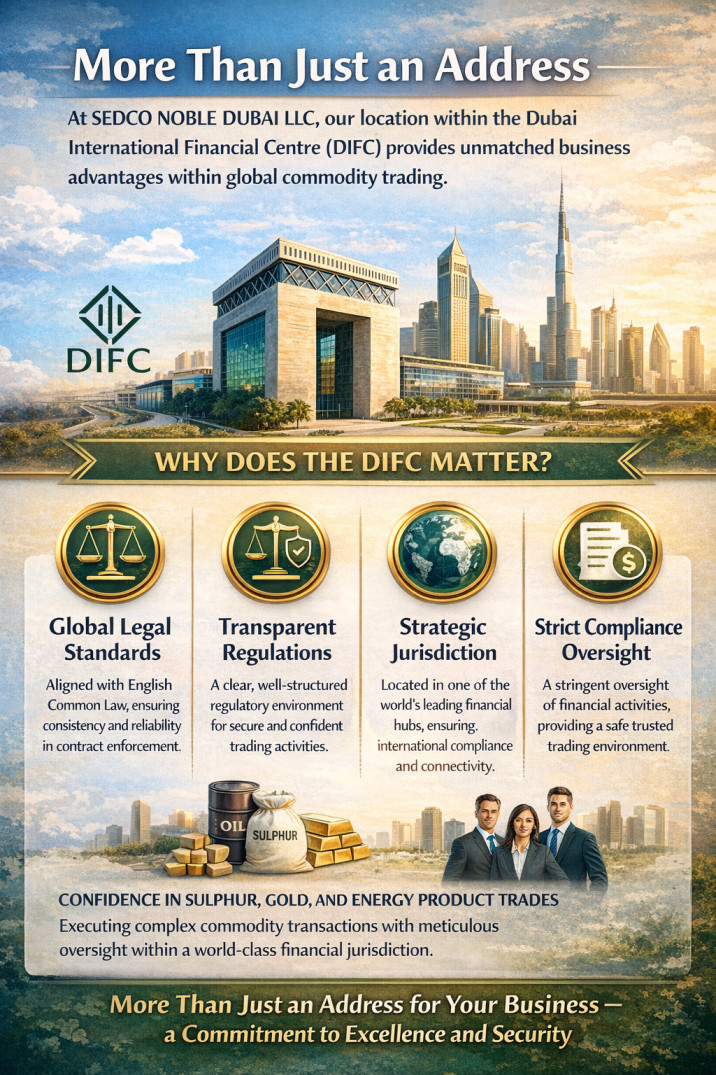
In global commodity trading, where transactions cross borders, legal systems, and regulatory regimes, the jurisdiction of your financial partner is not a minor detail—it's a critical component of transaction security and success. For SEDCO NOBLE DUBAI LLC, our registration and operations within the Dubai International Financial Centre (DIFC) are fundamental to our value proposition. It is the robust, transparent legal and regulatory framework that allows us to execute complex sulphur, gold, and energy product trades with unparalleled confidence for our clients. This post explains why this matters for your business.
Part 1: The DIFC Advantage – A Premier Global Financial Ecosystem
The DIFC is not merely a geographic location; it is a purpose-built, world-class financial free zone with its own independent, common-law judicial system and regulatory authority. Here’s how this directly benefits our clients:
1. Legal Certainty & Contract Enforcement:
Independent Courts: The DIFC Courts operate in English, follow English common law principles, and are staffed by internationally renowned judges. This provides predictable, fair, and fast dispute resolution—a stark contrast to the potential delays and uncertainties in many local jurisdictions.
Enforceable Judgments: DIFC Court judgments are readily enforceable in Dubai and across many other jurisdictions through reciprocal agreements. This global enforceability is a powerful deterrent against bad faith and a crucial safety net.
2. Robust, Proportionate Regulation:
DFSA Oversight: Our operations are regulated by the Dubai Financial Services Authority (DFSA), a regulator modeled on world-leading standards (like the UK's FCA). This ensures we operate with stringent Anti-Money Laundering (AML), Counter-Terrorist Financing (CFT), and Know-Your-Customer (KYC) protocols.
A Seal of Credibility: Partnering with a DFSA-regulated entity signals to your banks, insurers, and counterparties that you are working with a transparent, compliant, and seriously capitalized institution. It streamlines counterparty due diligence and builds trust instantly.
3. Financial Infrastructure & Connectivity:
Banking & Custody: The DIFC hosts branches of the world’s top financial institutions and specialized custodians. This gives us—and by extension, our clients—direct access to optimal banking arrangements, secure escrow services, and specialized vaulting for assets like gold.
Network of Professionals: We are embedded in a community of elite law firms, auditors, and consultants specializing in complex cross-border finance. This allows us to assemble the best advisory team for any unique transaction.
Part 2: Direct Benefits for Your Commodity Transactions
How does our DIFC foundation translate into tangible benefits for a trader or producer?
For Speed & Efficiency:
Faster Structuring: The clarity of DIFC law allows for cleaner, more efficient contract drafting. We avoid the "legal fog" that can bog down negotiations in less-defined jurisdictions.
Streamlined Banking: Transactions routed through the DIFC often experience smoother processing with international correspondent banks, reducing LC issuance and confirmation times.
For Risk Mitigation:
Political & Sovereign Risk Buffer: Operating in a financially and legally neutral zone insulates transactions from regional political fluctuations, providing a stable anchor for your deals.
Enhanced Counterparty Trust: Presenting a deal structured under DIFC law and involving a DFSA-regulated entity like SEDCO NOBLE significantly reduces counterparty anxiety, especially for new trading relationships.
For Complex & Structured Deals:
Innovative Structuring: The DIFC's legal framework is designed to accommodate sophisticated financial products. This enables us to create bespoke, secure structures for profit-sharing, prepayment facilities, and inventory financing that might be untenable elsewhere.
Ideal for Joint Ventures: As an "independent joint venture entity" ourselves, the DIFC is the perfect jurisdiction to host and manage the contractual frameworks for collaborative projects, such as a dedicated sulphur offtake agreement or a gold streaming deal.
Part 3: The SEDCO NOBLE Synthesis: Operational Heritage Meets Jurisdictional Excellence
Our DIFC base is the modern platform for our inherited legacy. It allows us to apply the operational precision from our drilling history within a financial and legal environment of equal caliber.
Discipline x Framework: Our culture of rigorous procedure thrives within the DIFC's clear regulatory framework. Compliance is seamless, not burdensome.
Global Reach x Local Intelligence: While the DIFC connects us to global standards, our deep, decades-long presence in the UAE provides the essential local market intelligence and relationships.
Clarity of Purpose: It is important to note: Sedco Noble Dubai LLC is not related to Schlumberger's Sedco Forex or Transocean. We are an independent entity that chose the DIFC deliberately as the optimal foundation for our next chapter in trade finance and investment.
Conclusion: Choosing a Partner with the Right Foundation
In commodity trade finance, the strength of a promise is only as good as the system that enforces it. Choosing a partner based in a jurisdiction with weak legal recourse or opaque regulation adds a hidden, yet monumental, layer of risk to your transaction.
By partnering with SEDCO NOBLE DUBAI LLC, you select more than a financier. You select a partner anchored in one of the world's most secure and sophisticated financial jurisdictions. You gain the confidence that comes from legal certainty, regulatory transparency, and institutional credibility—allowing you to focus on the commercial opportunity, secure in the knowledge that the foundational structure of your deal is rock solid.
Join the Conversation (4)
Leave a Comment
No account required! Just enter your name and email.
In our experience, structuring transactions through the DIFC consistently delivers meaningful time savings on banking processes, especially for letters of credit (LCs) and stand-by LCs (SBLCs) — which are critical in sulphur, gold, and energy deals.
Typical time reductions we see:
LC issuance: 3–7 business days faster on average when the applicant or beneficiary is DIFC-based or the transaction is governed by DIFC law, compared to deals routed through less internationally aligned jurisdictions (e.g., certain onshore Middle East or emerging-market locations).
LC confirmation / advising: Often 2–5 days quicker, because major international correspondent banks (HSBC, Standard Chartered, JPMorgan, Citi, etc.) maintain strong direct relationships with DIFC-licensed entities and recognize the English common law framework, which aligns closely with global trade finance standards.
Overall end-to-end banking cycle (from LC application to funds release on presentation): Clients frequently report 10–20% faster processing — sometimes shaving 7–14 calendar days off the entire cycle in mid-to-large transactions.
These gains come from:
Reduced KYC/AML back-and-forth (DIFC’s robust, transparent regulatory environment is well-understood globally)
Fewer queries on governing law and jurisdiction clauses
Direct access to DIFC-based relationship managers at the major banks, allowing quicker escalations when needed
Of course, exact savings depend on the banks involved, the complexity of the underlying trade, and documentation quality — but the DIFC advantage is consistently one of the reasons clients choose to route high-value commodity flows through Dubai.
If you have a current or upcoming transaction in mind, we’d be happy to run a quick benchmarking against recent comparable deals to show you the potential time/cost impact.
Looking forward to hearing more about your needs!
Being based in the DIFC—regulated by the Dubai Financial Services Authority (DFSA) and operating under an English common-law framework—gives us tangible, day-to-day operational edges that banks or intermediaries in other jurisdictions (e.g., onshore UAE, certain emerging markets, or even some European centers) often lack. Here's how it translates into faster, more decisive real-time action to safeguard your interests:
1. Proximity & Direct Access to DIFC-Based Banking & Regulatory Ecosystem
Major international correspondent banks (e.g., HSBC, Standard Chartered, Citi) have regional HQs or strong dedicated teams physically in or immediately adjacent to the DIFC. This means escalations on LC discrepancies, suspicious documents, or milestone breaches happen via direct relationship manager meetings or same-day calls—not through distant head offices with multi-layer approvals.
When a seller presents dubious docs (e.g., mismatched B/L dates, questionable assay certs for gold, or non-compliant moisture reports for sulphur), we can flag it pre-presentation and coordinate with confirming/issuing banks in hours—often securing a waiver, amendment, or hold on payment before documents even hit the advising bank. In non-DIFC setups, this can drag on for days/weeks due to slower correspondent chains.
2. Common-Law Predictability Enables Proactive Contractual Leverage
DIFC law (based on English principles) allows for clearer, more enforceable clauses in our financing agreements—e.g., step-in rights, acceleration triggers on missed milestones, material adverse change (MAC) provisions tied to document quality, and specific performance remedies.
This creates real pre-dispute pressure: If a seller misses loading deadlines or submits inconsistent docs, we can invoke contractual remedies (e.g., demand immediate cure, withhold drawdowns, or trigger security enforcement) with high confidence they'll hold up—without needing court escalation first. The common-law emphasis on commercial reasonableness and good faith (implied or explicit) gives us stronger grounds to push parties to rectify issues quickly, rather than litigate.
3. DFSA Oversight Drives Heightened Accountability & Speed
As a DFSA-regulated entity (assuming structured finance/trade activities fall under authorization), we operate under strict supervision focused on client protection, risk management, and conduct standards. This includes ongoing compliance monitoring and a culture of proactive issue resolution—DFSA expects firms to prevent harm, not just react.
In practice, this means our internal processes prioritize rapid intervention: dedicated compliance/trade teams review docs in real-time, and we can leverage DFSA-aligned relationships with banks for faster escalations. Regulated status also builds trust with counterparties—they know non-cooperation could trigger regulatory reporting, adding informal but powerful pressure.
Concrete Example: Sulphur Trade Intervention (Anonymized, Recent Case ~2025)
Scenario: 50,000 MT sulphur CIF to Southeast Asia. Mid-transit, seller presented docs with discrepancies (B/L weight short by ~2%, moisture cert from non-accredited lab, inconsistent purity specs vs. LC). Buyer flagged risk of rejection/contamination claims.
Our Action (DIFC Advantage in Play):
Within hours of receiving docs (pre-bank presentation), our team spotted issues via in-house review.
Leveraged DIFC proximity: Arranged same-day call with confirming bank's DIFC-based RM → secured conditional hold on negotiation pending amendments.
Invoked our financing agreement's MAC clause (clear under DIFC common law) → notified seller of breach, demanded immediate re-inspection/cert reissue, and threatened drawdown suspension/security enforcement.
Seller (a regional refinery with DIFC banking ties) responded within 24 hours—coordinated new survey at load port (via our network), amended docs, and cured discrepancies to avoid LC rejection.
Outcome: Payment released smoothly on arrival; no demurrage/claims; buyer avoided ~USD 300k+ potential loss. In a non-DIFC setup (e.g., distant intermediary), this could have led to prolonged disputes, rejected docs, or forced acceptance of sub-standard cargo.
Without the DIFC's ecosystem—proximity to banks, predictable common-law tools, and DFSA-driven accountability—these interventions would be slower, less forceful, and riskier. We turn potential disputes into quick fixes because we're embedded where the action happens.
If this aligns with challenges you've faced, feel free to share anonymized details of a past or upcoming deal—we can outline exactly how we'd apply this protective layer, including sample clauses or escalation protocols.
We're committed to making transactions reliable and stress-free.