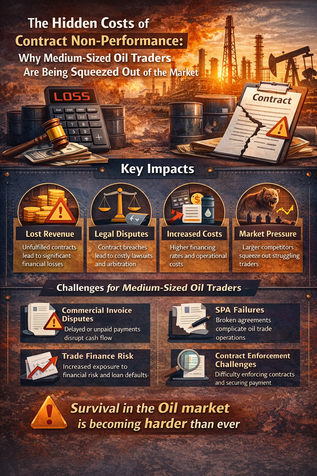
The Hidden Costs of Contract Non-Performance: Why Medium-Sized Oil Traders Are Being Squeezed Out of the Market
The international oil trade has always been a high-stakes game. But for medium-sized companies operating in the value chain between major producers and end-users, the rules of engagement have shifted dramatically in recent years. While headlines focus on price volatility and geopolitical disruptions, a quieter crisis is unfolding: the systematic erosion of trust and profitability caused by chronic contract non-performance.
This article examines the real-world impact of failed Commercial Invoices and unfulfilled Sales and Purchase Agreements on medium-sized oil traders—and why these companies are increasingly finding themselves caught between the operational demands of large suppliers and the financial fragility of small off-takers.
The Domino Effect of a Single Failed Transaction
Consider a typical transaction. A medium-sized trading company in Geneva agrees to purchase 50,000 metric tons of gasoil from a major refinery in Rotterdam, signing an SPA with payment terms of net 30 days. The trader then enters into a separate SPA with a buyer in West Africa, offering net 15-day terms—a standard practice that allows the trader to manage cash flow while earning a margin on the spread.
On paper, the transaction makes sense. The numbers work. The documentation is in order.
But then the West African buyer misses payment. Their own customer—a small retail distributor—has delayed settlement, citing customs clearance issues at the port. The Geneva trader now faces a liquidity shortfall. When the refinery's invoice comes due, the funds aren't there. The commercial invoice goes unpaid. The refinery triggers default provisions. Credit lines are frozen. Relationships cultivated over years evaporate overnight.
This scenario plays out thousands of times annually across the global oil trade. And while large international oil companies can absorb such losses as cost of doing business, medium-sized traders often cannot. For them, a single non-performance event can mean the difference between survival and collapse.
The True Cost Beyond the Invoice Amount
When analysts discuss non-performance, they typically focus on the face value of the unpaid invoice. But for medium-sized companies, the hidden costs extend far beyond the immediate financial loss.
Reputational Damage and Credit Access
In the oil trading world, reputation is currency. A single instance of non-payment—even when caused by a downstream customer's default—can destroy years of carefully cultivated trust. Banks and trade finance providers maintain sophisticated databases tracking payment performance. Once a company appears on these radar screens with a default flag, access to letters of credit tightens dramatically. Premiums increase. Limits decrease. Some lenders simply walk away.
The result is a paradox: a company that survives a non-performance event may find itself unable to secure the financing needed for future transactions, effectively strangling its growth even as it recovers from the immediate crisis.
Opportunity Costs and Market Position
Medium-sized traders operate on thin margins and high volume. Their business model depends on capital velocity—the ability to turn over inventory quickly and reinvest proceeds into the next transaction. When an invoice goes unpaid, that capital is trapped. While legal teams pursue recovery, competitors are capturing market share. Seasonal opportunities are missed. Supplier relationships that required preferential allocations are lost to more reliable counterparties.
The opportunity cost of a single non-performing invoice can easily exceed the invoice value by a factor of three or four when measured over a twelve-month horizon.
Management Distraction and Organizational Drain
Perhaps the most underestimated cost is the drain on management attention. When an SPA fails or an invoice remains unpaid, senior executives—the same people responsible for identifying new opportunities and negotiating future deals—are pulled into crisis management. Legal counsel must be retained. Recovery strategies must be developed. Relationships with affected counterparties must be managed.
For a large corporation with dedicated legal and collections departments, this is manageable. For a medium-sized trading house with lean operations, it is debilitating. Every hour spent chasing a defaulting buyer is an hour not spent building the business.
Structural Vulnerabilities That Amplify Risk
Understanding why medium-sized companies suffer disproportionately from non-performance requires examining the structural position they occupy in the value chain.
The Information Asymmetry Problem
Large suppliers—major refineries and international oil companies—typically maintain sophisticated credit departments and extensive databases on potential buyers. They know who has paid on time historically, who has defaulted, and who operates on the margins of financial viability.
Medium-sized traders, by contrast, often lack access to equivalent information about their downstream buyers. They rely on personal relationships, industry reputation, and whatever financial documentation the buyer chooses to provide. This information asymmetry creates a systemic vulnerability: the traders least able to absorb losses are often the least equipped to identify risky counterparties before signing an SPA.
The Working Capital Squeeze
The payment term mismatch described earlier—offering 15-day terms to buyers while accepting 30-day terms from suppliers—is not a choice but a competitive necessity. Medium-sized traders must offer attractive terms to secure downstream customers. Yet this practice leaves them perpetually exposed. A single delay in the chain creates a cascade of liquidity pressures.
Banks, unfortunately, rarely provide financing that bridges this gap effectively. Trade finance is typically structured around specific transactions with clear documentation, not around the working capital needs created by timing mismatches in the payment cycle.
Concentration Risk
Unlike major banks or diversified financial institutions, medium-sized oil traders cannot spread their counterparty risk across hundreds of transactions. A typical medium-sized trader might have ten to twenty active contracts at any given time. If one fails, that represents 5 to 10 percent of their active portfolio—a concentration risk that would terrify any prudent financial institution.
Yet this concentration is unavoidable. Building relationships in the oil trade requires focus and specialization. Traders develop expertise in specific geographies, specific products, specific corridors. Diversification dilutes that expertise and undermines competitive advantage.
The Compliance Burden: When Regulation Compounds Risk
In recent years, regulatory requirements have added another layer of complexity to contract performance. Anti-money laundering rules, know-your-customer requirements, and sanctions compliance have transformed the documentation required for international oil transactions.
For large companies with dedicated compliance teams, these requirements are manageable. For medium-sized traders, they represent a significant operational burden—and a new source of potential non-performance.
Consider a typical scenario: A buyer in a developing market provides all required documentation, signs the SPA, and receives the commercial invoice. But when payment is attempted, the buyer's bank flags the transaction for enhanced due diligence. Funds are frozen pending additional documentation. The buyer's compliance department, unfamiliar with international oil trade documentation, requests clarifications. Days pass. The payment deadline approaches.
The supplier, facing its own obligations upstream, has no choice but to declare the buyer in default—not because the buyer lacked funds or intent, but because compliance processes delayed settlement beyond contractual limits.
This scenario, increasingly common in today's regulated environment, represents a form of non-performance that neither party intended and neither party could easily prevent. Yet the consequences for the medium-sized trader are identical to those arising from fraud or financial distress.
Strategies for Survival: What Medium-Sized Companies Can Do
Given these structural challenges, what options exist for medium-sized companies seeking to protect themselves from non-performance risk?
Enhanced Due Diligence Protocols
The era of relying on personal relationships and reputation is ending. Medium-sized traders must adopt due diligence practices that rival those of larger institutions. This means:
Verifying bank references directly, not accepting printed statements
Conducting site visits to confirm operational capacity
Requiring audited financial statements, even for private companies
Checking beneficial ownership registers to understand who ultimately controls the counter-party
Monitoring payment behavior throughout the relationship, not just at on boarding
While these measures require investment, they represent insurance against catastrophic loss.
Structural Risk Mitigation
Traders can also restructure transactions to reduce exposure:
Requesting letters of credit rather than open account terms, even if this means accepting slightly lower margins
Structuring shipments in smaller lots, so that a single default does not represent concentrated exposure
Building escalation clauses into SPAs that adjust payment terms based on performance history
Requiring personal guarantees from principals of smaller buying companies
Technology Adoption
Manual processing of invoices and documentation creates delays that amplify risk. Investing in systems that automate invoice generation, payment tracking, and document management reduces errors and accelerates the payment cycle. Some platforms now offer real-time visibility into payment status, allowing traders to identify potential delays before they become defaults.
Portfolio Diversification
While specialization remains important, traders can reduce concentration risk by expanding into related product lines or geographic corridors. A company trading only Nigerian crude is dangerously exposed to any disruption in that market. A company that trades Nigerian crude, West African refined products, and Mediterranean fuel oil has multiple revenue streams and can absorb the loss of any single transaction.
The Path Forward: Industry-Level Solutions
Ultimately, protecting medium-sized companies from non-performance risk requires industry-level action.
Credit information sharing platforms that allow traders to report payment performance—both positive and negative—would reduce information asymmetry. Industry associations could develop standardized due diligence protocols and maintain databases of verified counterpart information. Trade finance providers could develop products specifically designed to address the working capital gaps created by payment term mismatches.
Regulators, too, have a role. While compliance requirements are essential, creating streamlined procedures for routine international trade transactions would reduce the delays that currently trigger unintended defaults.
Conclusion
The non-performance of Commercial Invoices and Sales and Purchase Agreements is not merely a technical legal problem. It is a structural challenge that threatens the viability of medium-sized companies throughout the oil value chain. These companies—the critical links between major producers and end-users—operate with thin margins, limited capital reserves, and significant information asymmetries. When contracts fail, they suffer disproportionately.
Addressing this challenge requires recognition that non-performance is rarely a simple matter of bad faith or financial distress. It is often the product of systemic vulnerabilities, operational complexities, and timing mismatches that no single company can solve alone.
For the industry to remain healthy and competitive, stakeholders at every level—suppliers, buyers, financiers, and regulators—must work together to create a trading environment where medium-sized companies can thrive, not merely survive. The alternative is a market increasingly dominated by a handful of players large enough to absorb any loss, with all the concentration risks that entails.
In an industry built on relationships and trust, the cost of losing the middle market may prove far higher than anyone has yet calculated.
Join the Conversation
Leave a Comment
No account required! Just enter your name and email.
No comments yet. Be the first to share your thoughts!