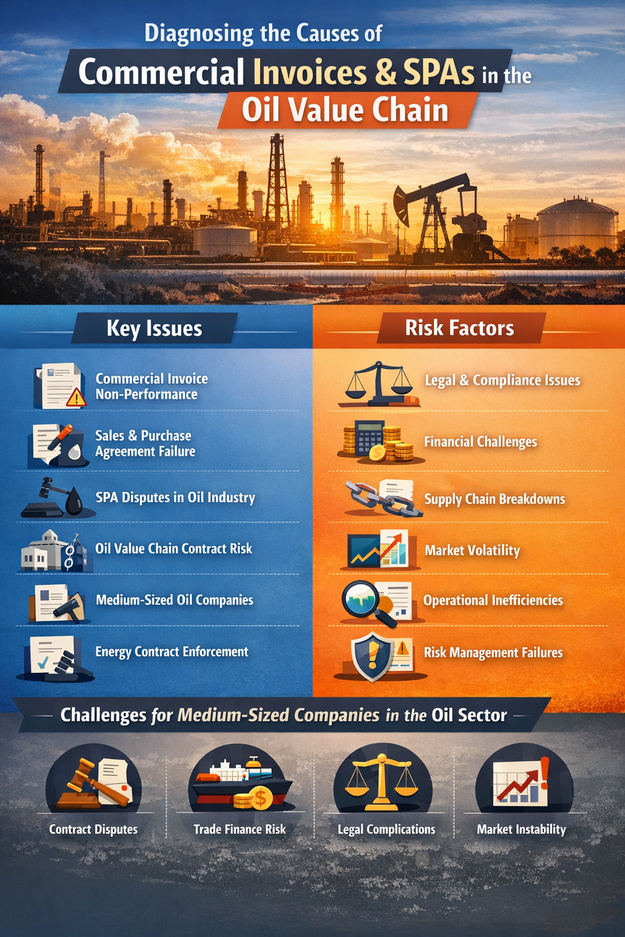
Diagnosing the Causes of Non-performance of Commercial Invoices (C.I.) and Sales and Purchase Agreements (SPA) Executed by Medium-Sized Companies in the Oil Value Chain
1.0 Understanding the Key Concepts
To properly diagnose the causes of non-performance, it is essential first to establish a clear understanding of the primary instruments and the key players involved in the oil trade.
1.1 What is a Commercial Invoice (C.I.)?
A commercial invoice is a legal document issued by a seller (exporter) to a buyer (importer) in an international transaction. It is essentially the bill for the goods. While a standard receipt confirms that a transaction took place, a commercial invoice serves a much broader and more critical purpose, especially in the context of the international oil trade. It indicates the following:
Customs Clearance: This is its most critical function. Customs authorities in the destination country use the commercial invoice to determine the value of the shipment and calculate any applicable duties and taxes (such as VAT or GST) that the buyer (importer) must pay.
Identification of Goods: It describes exactly what is being shipped, including quantity, weight, and product specifications. This helps customs officers verify that the items are permitted into the country and whether they require special permits.
Contract of Sale: It serves as proof of the agreement between the buyer and seller, detailing the price and the terms of the sale (Incoterms).
Payment: It acts as the seller's formal request for payment from the buyer.
Other key information found on a commercial invoice includes:
Seller/Exporter Information: Name, Address, and contact details.
Buyer/Importer Information: Name and address.
Consignee: Often the same as the buyer, but could be a different recipient address.
Unique Invoice Number: For tracking and reference.
Invoice Date: The date the document was issued.
Description of Goods: A detailed description of the type of oil product being shipped, often including the Harmonized System (HS) code.
Quantity: Volume of product being shipped (e.g., in barrels or metric tons).
Unit Value & Total Value: The price per unit and the extended total.
Total Invoice Value: The total amount the buyer must pay.
Currency: The currency used for the transaction (e.g., USD, EUR).
Incoterms: International rules defining responsibility for shipping, insurance, and customs clearance (e.g., FOB, CIF).
Country of Origin: Where the oil product was produced.
Shipping Details: Weight, dimensions, and number of packages.
1.2 What is a Sales and Purchase Agreement (SPA)?
A Sales and Purchase Agreement (SPA) is a legally binding contract between a seller and a buyer that outlines the terms and conditions under which a specific product is sold. A robust SPA covers every detail of the transaction to prevent disputes later. Key sections include:
Parties Involved: Legal names and addresses of the buyer and seller.
Description of Goods: A detailed specification of what is being sold, covering technical specifications, quality grades, and allowable defect rates.
Quantity and Price: The total volume (e.g., 10,000 MT) and the agreed price (e.g., $500.00 per MT).
Delivery Terms (Incoterms): Specifies responsibility for shipping costs and insurance (e.g., FOB, CIF).
Payment Terms: How and when the seller gets paid (e.g., Letter of Credit, Wire Transfer, Open Account).
Delivery/Shipment Date: The deadline by which the goods must be shipped.
Inspection and Acceptance: Defines the buyer's right to inspect goods and the process if goods are damaged or non-conforming.
Title Transfer: The exact moment when ownership of the goods passes from seller to buyer.
Force Majeure: A clause freeing both parties from liability in case of extraordinary events.
Dispute Resolution: Specifies whether disputes will go to court or arbitration.
The SPA is critically important because it provides legal protection, serves as the basis for Letters of Credit, and offers clarity to prevent misunderstandings.
1.3 The Role of Medium-Sized Companies in the Oil Value Chain
To understand their specific challenges, it is necessary to visualize the transaction value chain as a series of sequential steps that facilitate the delivery of oil products from the producer to the end buyer. This chain includes everything from manufacturing and logistics to financing, marketing, and sales.
Medium-sized companies are the "critical link" or the "engine room" of this chain. They are neither the giant International Oil Companies (IOCs) that control entire industries nor the small retail distribution outlets. They occupy a powerful and often flexible middle ground.
Their role can be broken down as follows:
1. The "Glue" in the Value Chain: They act as the critical link between IOCs/refineries and retail outlets within the downstream value chain, connecting entities in the upstream sectors with their counterparts downstream.
2. Value Addition: Many medium-sized companies do not simply pass products along; they add significant value through activities such as the blending of oil products.
3. Providers of Critical Services: The value chain is not just about physical goods. Medium-sized companies are vital providers of services that make transactions possible. This includes specialized logistics (e.g., freight forwarders with expertise in shipping oil products to specific regions, handling complex documentation and customs clearance) and trade finance and quality control (e.g., inspection agencies or trade finance houses that provide trust and liquidity by verifying product quality against the SPA or bridging the gap between production and payment).
In summary, medium-sized companies bridge existing gaps in the transaction chain and facilitate the execution of Commercial Invoices and Sales and Purchase Agreements.
They also provide the stability, specialization, and mid-level volume that large corporations depend on, while also offering market access that small companies need to grow. They manage the real-world complexity that lies between the signed contract and the delivered goods.
---
2.0 Diagnosing the Causes of Non-performance
Diagnosing the causes of non-performance for Commercial Invoices (C.I.) and Sales and Purchase Agreements (SPA) executed by medium-sized companies in the oil value chain reveals a set of interconnected issues.
These ranges from structural power imbalances and poor capitalization to operational inefficiencies and, in some cases, outright fraud.
The following is a diagnostic breakdown of the root causes, categorized for clarity.
2.1 Structural and Financial Causes
Poor Capital Base : A significant, often overlooked, cause of non-performance originates with the small retail companies ( Offtakers ) operating within the downstream value chain. An estimated 90% of these small companies are single-holding entities with a poor capital base and limited access to bank credit. Consequently, they face three critical barriers:
They are unable to accumulate the working capital needed to streamline and automate their internal processes.
They cannot provide proof of financial ability to purchase product, which is a prerequisite for obtaining funds needed to pay for the products.
They lack funds to cover pre-transaction expenditures.
Their ability to pay the face value of invoices are entirely dependent on their receipt of the Proof of Product and the subsequent sale of that product.
Because they lack proof of financial capability, they often cannot receive the Proof of Product in the first place, creating a fatal barrier to transaction closing.
Power Imbalance and Delayed Payments: A primary cause of non-performance is the significant power imbalance between large sellers/suppliers (major oil companies and refineries) and their medium-sized buyers. This imbalance grants the former considerable bargaining power. Large sellers often dictate onerous payment terms, stretching them from net 30 to net 60, 90, or even 120 days. This practice, sometimes referred to as "net never" terms, forces medium-sized suppliers to function as unwilling sources of zero-cost financing.
While this directly strains the mid-sized companies, the effect is even more pronounced on the small players in the downstream sector. When large buyers delay payment, it creates a cascading liquidity crisis that leads to non-performance of both the commercial invoice and the SPA signed with smaller entities across the chain.
Cash Flow Vulnerability: Medium-sized companies often operate on thinner margins and have less access to affordable credit than large corporations. These balance-of-payment realities are even more acute for the small retail outlets in the downstream/distribution sector. When their invoices are not paid on time, their working capital is squeezed, making it difficult to meet their own obligations, pay employees, or invest in new projects. This financial fragility makes them highly susceptible to the domino effect of a single delayed payment from a dominant customer.
2.2 Operational and Administrative Causes
Manual and Inefficient Processes: The accounts payable (AP) and receivable (AR) processes in the industry can be surprisingly manual. Mid-sized companies, for example, may be flooded with hundreds of invoices in unstructured formats like PDFs or paper, which do not integrate neatly with modern accounting systems. This manual processing leads to delays in coding, validating, routing, and approving invoices, which in turn slows down payment and increases the risk of errors. The lack of automation and integration creates friction and opacity in the payment cycle, contributing to disputes and delays.
Formula-Based Pricing and Invoice Corrections: A unique technical challenge in the oil industry is the use of formula-based pricing, where the final price of goods may not be determined until after delivery. This often requires the supplier to issue a second "true-up" or "correction" invoice. From a tax compliance perspective, this creates significant complexity. Taxes are generally due when an invoice is issued, meaning both the initial and final invoices could technically require tax remittance. If not handled correctly with formal credit or debit notes, this administrative complexity can lead to payment delays and disputes, constituting a form of non-performance.
2.3 Fraud and Compliance-Related Causes
· False Invoicing Schemes: A more sinister cause of non-performance is the deliberate issuance of false invoices. In the refined oil products sector, sophisticated fraud schemes have been uncovered where companies use techniques to artificially inflate inventory data and issue VAT invoices for product that was never actually sold. These schemes, often run through shell companies, are designed to evade consumption tax and can involve hundreds of millions of dollars. While the perpetrators are committing fraud, for the unsuspecting buyer, this represents a catastrophic failure of the commercial invoice to represent a legitimate transaction, leading to legal and financial non-performance.
2.4 Systemic and Informational Causes
Misaligned Corporate Strategies: Within large seller/supplier organizations, different departments may have conflicting goals. The treasury department might prioritize cash preservation by delaying payments, while procurement aims to strengthen supplier relationships, which might require faster payments. This internal misalignment creates unpredictable payment behavior, making it impossible for medium-sized suppliers to rely on the payment terms agreed in the SPA. The lack of a unified strategy results in a system where cash flow for suppliers becomes erratic and relationships are strained.
3.0 Conclusion
In summary, the non-performance of Commercial Invoices and SPAs for medium-sized companies in the oil and gas industry is rarely attributable to a single factor. It is typically the result of a combination of their weaker bargaining position against large clients, the precarious financial state of smaller downstream players, industry-specific operational complexities like formula pricing, and systemic issues within their customers' own organizations.
Addressing these challenges requires a multi-faceted approach involving better capitalization, process automation, and more balanced contractual relationships.
Join the Conversation
Leave a Comment
No account required! Just enter your name and email.
No comments yet. Be the first to share your thoughts!